
“Any sufficiently advanced technology is indistinguishable from magic.” – Arthur C. Clarke

David and Thinker
It is an honor and delight to have discussed, sometimes debated, leading edge ideas in an array of disciplines with more than my fair share of the world’s smartest people. Many of them have become close friends, and in many cases we worked together.
Some of them include Hal Williams (Engineering), Paul MacCready (Human powered flight), Hank Medwin (Acoustics), Morley Baer (Photographer), Doug Scott (Climber), Edmund Hillary (Everest Climber),
Frank Costin (Vehicle Designer), Steve Hunt (Hang Glider AeroEngineer), Donald Kennedy (Scientist/Publisher), William Proxmire (Senator, Golden Fleece Awarder), Archibald Cox (Prosecutor), Gary Kildall (Pioneer Software Publisher / Programmer), Cordner Nelson (Track Expert/Publisher), Paul Marmet (Physicist/Cosmologist) and Gordon Newell (Sculptor).
Paul MacCready once introduced me to Murray Gell-Mann (Nobel Prize in Physics) at a party, however I forgot what Gell-mann’s expertise was and momentarily grew uncharacteristically tongue-tied (“brain-tied” ?) and unable to utter anything beyond the mundane.
With those better experiences as a basis, I’ve been looking for a good definition of the idea “genius” for decades and never found any adequate definitions, explanations, quotes or poems. Inspired recently – here’s my offering:
Definition: “Genius” is not a form of magic, it is simply when a person meaningfully understands a many-faceted subject AND can do something useful with that understanding.
It is like competently commanding a many dimensional jig-saw puzzle of knowledge; having a command of a large number of interdependent ideas and all the ways they interact together – all at once.
In more detail —
Most people can understand a single constant-ratio or linear relationship like counting numbers related to distance. Numbers and distance increase at a regular (linear) rate.
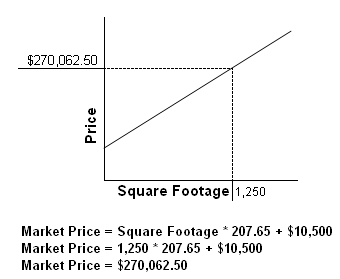
Constant Ratio Example
Adding Dimensions
When ideas are combined each new relationship adds another dimension. For example adding the altitude of a walking path along its distance adds a dimension. While the distance traveled increases in a clock like fashion, the altitude of a path can vary dramatically.
Non-Linear Relationships
A non-linear relationship is when one phenomenon increases steadily while a related phenomenon changes its rate; it could accelerate. An example is timing a ball dropping. A clock registers a steady rate, while a dropped ball speeds up going down. A linear relationship here would be the ball going at the same speed – not accelerating.
Some subjects have one non-linear relationship. Other subjects have dozens of non-linear relationships.
Mode Change or Phase Change Relationships
Temperature often adds a non-linear dimension (complexity) because sometimes dramatic things happen at specific places, such as a change in phase from liquid to gas as when water boils. For example water turns into a solid — ice below 32 degrees F and boils into a gas, or steam at 212 degrees F (100 C).
Genuine Understanding vs. Parroting
Nobel Prize winner Richard Feynman once declared in a speech in Brazil —
Feynman was illustrating the dramatic difference between simply “Parroting” or echoing information that a student is given, and when a student genuinely understands the subject.
Putting it all together
A Genius understands how all the many facets or phenomena of a topic fit together, how they compliment each other, how they conflict or limit each other, what the data gaps and reasoning problems are, where relationships are directly proportional (constant ratio) or how they are non-linear, what facets are most important, and probably most importantly — what can be ignored and when.
There are different degrees of genius as well as different types (science, creative, understanding, artistic, human relations, etc.).
When someone commands a field so well, their understanding may be so far beyond what others ignorant of the subject can comprehend – their mastery may appear to be magic – something like Arthur C. Clarke’s Third law quoted at the top of this article.
Understanding is Not Enough – Achieving Required
However, genuine top geniuses in their field (particularly those I mentioned at the start of this article) can also explain all these parts to others. This means they can examine each facet of a subject carefully and explain it so that others can understand.
Doing something with that understanding can range from simply teaching a subject to one other person, writing it down in a book so others can understand it — to building a rocket that lands humans on the moon and returns them safely to Earth.
In short “Genius is not magic, it is competently achieving complex deeds.”
What do you think ?