by David Dilworth
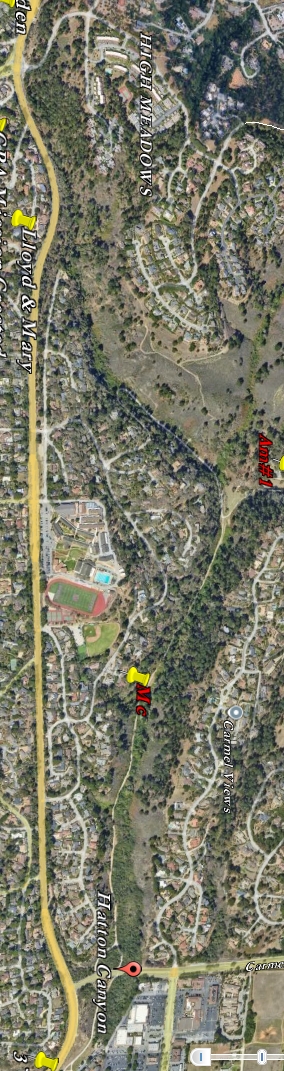
Hatton Canyon (green vegetation) to the right of Highway One (yellow)
In 1952 California’s evil Dept of Transportation (CalTrans) announced intention to destroy a quiet, spearmint-scented Forest Canyon next to Carmel-by-the-Sea to build a 3-mile, 4 lane Los Angeles style freeway next to Carmel in Hatton Canyon; right behind Carmel High School.
Faceless Sacramento bureaucrats and technocrats (including Caltrans District 5 Director Tom Pollack, and Greg Albright) recklessly decided to destroy 21 acres of a serene forest; home to deer, Mountain lions, and gentle red-legged frogs which eventually received Endangered Species Act protection.
Cal-Trans forest destruction proposed chainsawing some 31,000 native (many ancient) Monterey pine trees along with 10-12 acres of wetlands. (Final EIR)
It took 48 years of tremendous controversy and powerful opposition and a successful lawsuit for the awful project to die, or at least get buried, when the Governor Davis signed the 2000 state budget authorizing purchase of Hatton Canyon for California State Parks.
At the time of final agency approval the Sierra Club along with the City of Carmel opposed the Hatton Canyon Freeway. Both had reversed their positions, with the City of Carmel reversing its position on the Hatton Canyon Freeway five times. Incidentally, Caltrans also reversed its position twice.
Their opposition was improved thanks to a local group of caring residents, led by Noel Mapstead operating as the Sierra Club Transportation Committee. This group rose up to protect the lovely native canyon with public education campaigns and including teaching science, law and leading nature hikes through the Canyon.
An additional collaborative group, Hatton Canyon Coalition, organized the winning lawsuit featuring the City of Carmel, the Sierra Club and the Monterey Regional Parks District. On the other side was a local group led by Lois Starnes (who lived next to the existing Highway One) fighting for the freeway.
Key events —
1953 Caltrans formally designates Highway 1 past Carmel (Not Hatton Canyon) as a Freeway
1953 Carmel Village votes to Oppose the Freeway – led by Councilman Jaques and a “storm of citizen protest”
1954 Caltrans provides Hatton Canyon Alternative – Carmel Village supported it.
1957 Monterey County supports Freeway in Hatton Canyon; formally entered into a Freeway Agreement with the State Department of Transportation embracing the Hatton Canyon alternative
1960’s – 1970s Carmel Mayor Gunnar Norberg led opposition to the freeway.
1970’s and early 1980s intrepid Carmel Pine Cone Publisher Al Eisner and Michael Kelly fought back the Hatton Canyon Freeway.
1982 Caltrans tries to scrap the Freeway in Hatton Canyon, but Sierra Club members Roy and Charlotte Anderson living along Highway One get Sierra Club to Support the Hatton Canyon Freeway and then get Carmel Village to do the same.
1983 Caltrans included the project in its 1983 Improvement Program, for construction in 1988.
1986 Caltrans and DoT release Draft EIR with “every public entity supporting it”, accompanied by another Storm of opposition.
1986, December 11 Caltrans specifically identified LOS C (meaning moderate traffic delays) as the project goal (Bad goal, which ultimately lost them the lawsuit)
1987 (6 January) Carmel Village votes to Support the Hatton Canyon Freeway based on the Draft EIR
1987 (January 7) Sierra Club letter Supporting the Hatton Canyon Freeway based on the Draft EIR (pushed by Roy and Charlotte Anderson who lived next to Highway one)
?1987 Sierra Club Transportation Committee formed by Noel Mapstead (organizer), Susan Resendez-Davis (Den Mother) & Paola Berthoin (artist, author & World class chef)
1989 Sierra Club changes position now Opposes Freeway in Hatton Canyon
1990 (March) Carmel Village reverses, votes to Oppose the Freeway
1988 Hatton Canyon Coalition first meeting organized by David Dilworth at his Carmel Woods home. Skip Lloyd agreed to serve as Chairman.
? Press Conference with KSBW-TV exposing how State Funding for Hatton Canyon could be transferred to Prunedale Bypass organized by David Dilworth & Paola Berthoin at Highway one intersection with Carmel Valley Road.
1991, October 7 US-Dept of Transportation certified the Final EIS/R
? and CalTrans approved Environmental Impact documents
1993? Another outrageous Caltrans’ Plan is uncovered. They Plan to widen Big Sur Highway to 4 lanes all the way to San Luis Obsbo .
1996 (Sept. 13) Legal Victory: State Appellate Court rejects the Hatton Canyon CEQA Environmental Impact Report (2-1) – for failing to discuss Cumulative Impacts of past, present and future projects plus the Hatton Canyon freeway on the wetlands, Monterey pine and Hickman’s onion.
? date? California Legislature dramatically improves who makes transportation project decisions. Changes from un-elected State Bureaucrats to Local Elected Officials – called Transportation Agencies.
1999 Monterey Transportation Agency (TAMC) votes to move all Hatton Canyon funding to the Prunedale Bypass.
1999 (Feb 19) CalTrans and Fed Highway Admin Rescind their approvals of Hatton Canyon freeway, and intend to voluntarily rescind the Coastal Commission approval. Army Corps of Engineers reports they have stopped processing their permits.
2000 Governor Gray Davis signed the state budget authorizing $2.5 million purchase of Hatton Canyon for California Coastal Conservancy. It is ultimately given to California State Parks.
# # #
References:
Appellate Court Decision
https://law.justia.com/cases/federal/appellate-courts/F3/123/1142/624985/

1962, my family moved into a home on Whitman Circle, directly behind Carmel High School, and about half way down the canyon. The lot was an acre an a half and I think we paid something like $42,000 for it. I was 2. Six months later some people from the state highway department (long before it was called Caltrans) came to us and said they were going to put a freeway through our property. My mother often said it would “take six feet out of our living room.” The state bought our house but we lived in it and paid rent until 1968.
But before we moved out someone from the state came to our door one day and said our house would be spared. Instead, they would fill in the canyon and run the freeway down the middle, they just wanted to keep half an acre for easement. By this time my parents had pretty much decided to move to Oregon so the house was sold at a public auction for $36,000. I watched the auction from a tree alongside our patio.
I grew up, got married, and moved back in 1984.
I got involved in the fight. It started innocently enough with a letter to the Pine Cone. People said I was making a lot of sense so over several years I wrote many more letters and one or two guest commentaries in the Herald and Pine Cone.
I attended a hearing on the Draft EIR then wrote a detailed letter pointing out several flaws in the document. Chief among these was the poor analysis of the most popular alternative (“Alternative 4”), widening the existing highway to four lanes. It offered no improvements to the signalized Carmel Valley Road intersection which was the main bottleneck. So I took a pencil and some tracing paper, laid it over the freeway drawings in the EIR, and and drew a simple interchange that fit within the Right-Of-Way. I transferred the design to regular paper and submitted it with my comments. Much to my surprise a nearly identical design appeared in the Final EIR as “Alternative 4 Modified” and it became the preferred project among freeway opponents.
Meanwhile, with guidance from Noel Mapstead, I began photographing the entire canyon from Carpenter Street to Carmel Valley Road. It took a few months. I was hoping the images would help sway public opinion, or, if the freeway was built there would at least be a record of what came before. I submitted a proposal to Monterey Bay magazine for a photo feature, and at first the editor seemed interested. But in the end he turned me down.
You mentioned Greg Albright in your post as the chief villain. I actually liked him. He was much more sympathetic to my views than other Caltrans engineers. We had a really good conversation in 1995. It was just after the Carmel River Bridge washed out and while the new one was being built. I was working at the Crossroads Cinema which used to be right next to the bridge. He called me there. My wife gave him the number as I was attending to some business while the theater was closed. We talked about the freeway and the new bridge as I was watching it being built. I don’t remember what was said, but we talked for quite awhile and I had a lot of respect for him personally after that, even though we didn’t agree.
The one guy from Caltrans who drove me nuts was a guy named Jones, who retired before Greg came along. Jones worked on the freeway from the beginning and he was determined to see it through before he retired. He blew off my suggestion that eventually became Alernative 4 Modified and walked away.
I didn’t mean to go on this long, but your post brought back a flood of memories.
Thank you for your marvelous notes & history James.
I faintly remember a fierce, arrogant Caltrans official that fits your description of Jones.
Let me clarify, Greg Albright was not the chief pushing the freeway. During the 1990’s, I believe Tom Pollack was District 5 Director at the time. He was Greg’s boss. There was one other Caltrans fellow who regularly showed up with Greg. Both of course taking orders from Pollack.